
The most mass-produced aircraft in history: why the Cessna 172 became an aviation legend
The history of aviation is usually associated with giants. People recall long-haul airliners, military aircraft, or supersonic projects. However, if you ask a simple question - which aircraft became the most produced in history - the answer will unexpectedly be quite different.
It is not about giant airliners or combat machines. The leader turned out to be a small training and touring aircraft that thousands of pilots consider their first "flying desk."
Today we will talk about a small but legendary aircraft. What do you think is the most produced and sold aircraft in aviation history?
The question itself creates the right intrigue. Intuitively, most people would name well-known airliners - for example, Boeing 747 or Airbus A350. But in reality, the scale of serial production in aviation is distributed quite differently.
Airbus A350? Boeing 747? Of course not. It’s the Cessna 172!
The Cessna 172 Skyhawk is one of those rare technical products that managed to occupy a unique niche and hold it for decades. Since its introduction in the mid-20th century, this aircraft has become the standard for initial flight training.
From 1956 to 2020, more than 44,000 of these aircraft were built!
For aviation technology, this is a colossal number. Even most commercial airliners do not come close to such production figures.
Essentially, the Cessna 172 has become the baseline entry point into the profession of pilot. That is why almost every professional pilot has completed at least part of their training on this aircraft.
And it will also be hard to find a pilot working in the industry today who hasn’t logged a sufficient number of hours in the Cessna 172 cockpit.
A logical question arises: why has this aircraft been so successful?
To understand this, one must consider its design, the history of its emergence, and the features that made it the standard for flight schools around the world.
In this material, we analyze statements from the video and check them for factual accuracy.
Why the Cessna 172 Became the Favorite Aircraft of Flight Schools
Why has the Cessna 172 become the favorite of flight schools around the world?
The answer to this question lies in a combination of several factors. It is not just one characteristic that matters, but rather a balance between safety, simplicity, and cost-effectiveness.
First of all, it is a sturdy, robust, and predictable aircraft with reliable avionics.
For training aviation, this is a critically important parameter. Students make mistakes - and the aircraft must forgive them. The design of the Cessna 172 was originally created with an emphasis on high stability and clear response to the controls.
The high-mounted wing plays a key role here. This configuration improves lateral stability, as the center of mass is located below the wing. This makes the aircraft more stable in flight and reduces the likelihood of sharp rolls.
Secondly, it has excellent payload capacity.
For training flights, this means the ability to carry an instructor, a student, and additional equipment without exceeding safe weight limits.
Thirdly, it has good climb performance compared to other light training aircraft.
Climb performance is primarily important for safety. The ability to gain altitude quickly gives the pilot more time to make decisions in emergency situations.
Fourthly, it is inexpensive to operate and has remarkable reliability.
It is precisely the economics that made the Cessna 172 a mass-market aircraft. Flight schools around the world focus on the cost per flight hour, and this aircraft has proven to be optimal in terms of price, fuel consumption, and maintenance.

Simplicity of management as a key factor for success
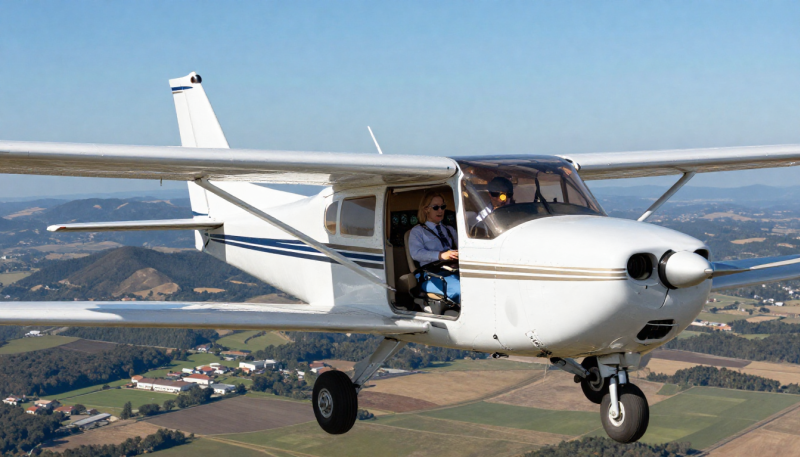
Thus, this aircraft is easy to handle due to its aerodynamic design, harmonious control, and smooth flying manners.
The term "harmonious control" in aviation refers to the balanced response of the aircraft to the pilot's actions. The forces on the yoke and pedals should be predictable, without sharp or unexpectedly strong reactions.
It is these characteristics that make the Cessna 172 an ideal training machine.
In addition, the high-wing design and circular rear window provide the pilot with a clear view of the terrain.
Visibility is another important aspect. During training, the pilot must constantly monitor the space around the aircraft to avoid collisions with other aircraft.
The high wing improves visibility downwards and sideways, which significantly eases visual navigation.
And the low landing speed, thanks to excellent flaps, makes landing the aircraft quite simple.
A low landing speed means that the aircraft can land on relatively short runways while remaining controllable.
For beginner pilots, this significantly reduces the stress level during landing - one of the most challenging phases of flight.
How the most mass-produced aircraft came to be
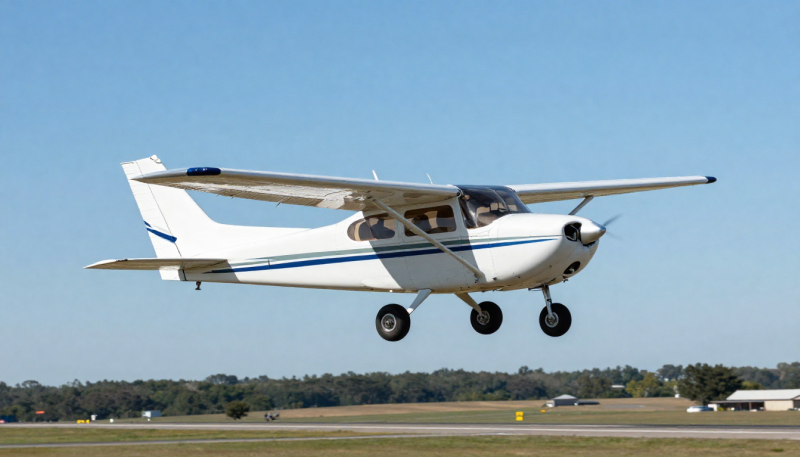
Cessna 172 — a single-engine monoplane with a high-mounted wing and an all-metal fuselage.
The aircraft appeared in the mid-1950s - a period of rapid growth in private aviation in the USA. At that time, there was an idea to create a "flying car" accessible for mass use.
This American four-seat aircraft manufactured by Cessna Aircraft Company made its first flight on June 12, 1955.
Interestingly, the project turned out to be successful almost immediately.
It was an instant success, and by 1956, in its first full year of production, more than 1400 aircraft were built.
For the aviation industry, such production rates were extremely high. This showed that the market for light aircraft was significantly broader than previously thought.

Design solutions that changed the fate of the model
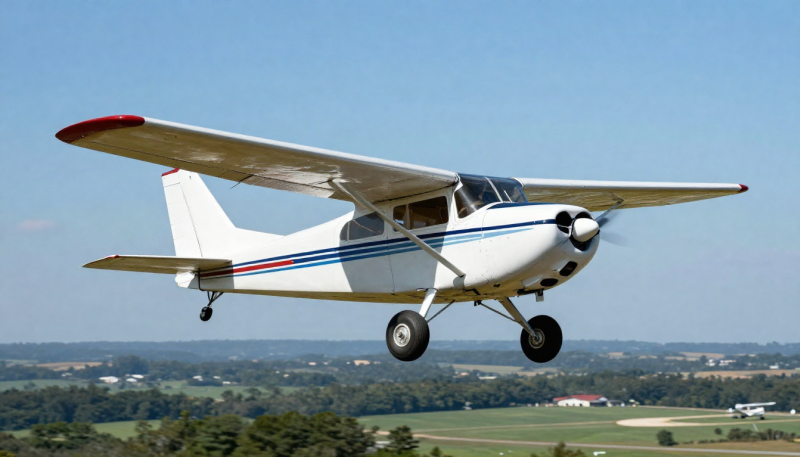
One of the key decisions in the history of the airplane was the change in the type of landing gear.
Cessna 172 was developed based on the 1948 Cessna 170.
The previous model had a tailwheel, which required more experience from the pilot during taxiing and landing.
Cessna engineers faced fierce resistance from the marketing department when they proposed building an aircraft with a tricycle landing gear instead of a tailwheel.
This was a principled dispute. The tailwheel landing gear was considered a traditional solution, but the tricycle configuration made the aircraft significantly easier to handle.
In the end, engineering logic prevailed.
Ultimately, the engineers won, and the Cessna 172 with tricycle landing gear went into production.
This decision became one of the key factors in the aircraft's popularity among beginners.
Engines and Technical Evolution
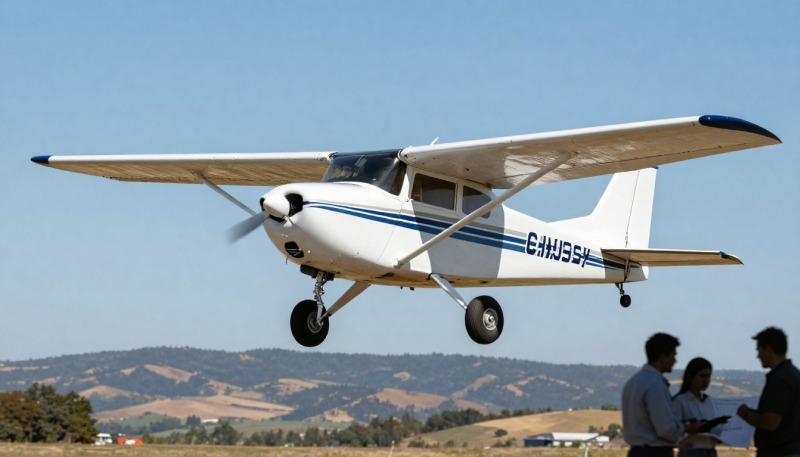
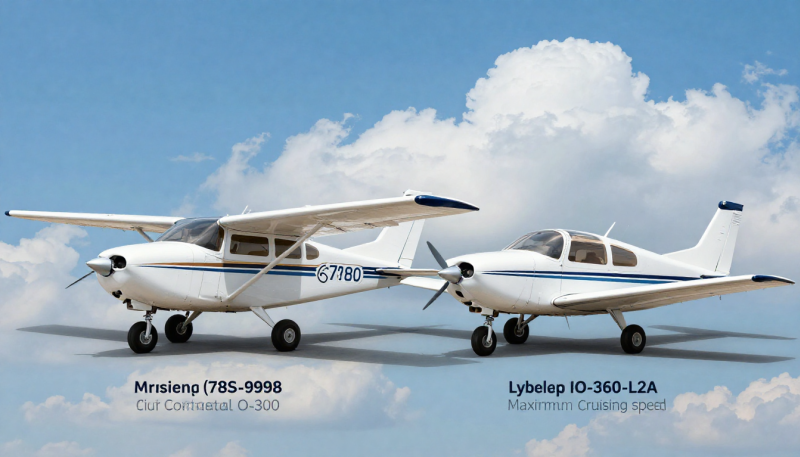
The original Cessna 172 was equipped with a horizontally-opposed six-cylinder piston engine Continental O-300 with a power of 145 hp.
This engine layout is widely used in light aviation. Horizontally-opposed engines are known for their compactness, good cooling, and high reliability.
Over time, the aircraft was upgraded.
The current model 172S, introduced in 1998, is equipped with a modernized 180-hp Lycoming IO-360-L2A.
This has improved its performance.
maximum cruise speed 230 km/h. maximum range 1185 km.
Such parameters make the aircraft suitable not only for training but also for private flights over medium distances.
World record for flight duration
It is this "little one" that holds the world record for flight duration.
This record has become one of the most famous stories in aviation.
The record was set on December 4, 1958, by pilots John Cook and Robert Timm in a brand new Cessna 172.
The flight lasted an incredibly long time.
They remained in the air for 64 days, 22 hours, 19 minutes, and 5 seconds!
The secret was that the plane was refueled in mid-air from a moving car, while the pilots took turns resting.
This record has still not been broken.

Why the airplane remains popular today
The Cessna 172 is constantly being upgraded.
The current Cessna 172 Skyhawk is equipped with the latest technology integrated into the onboard avionics.
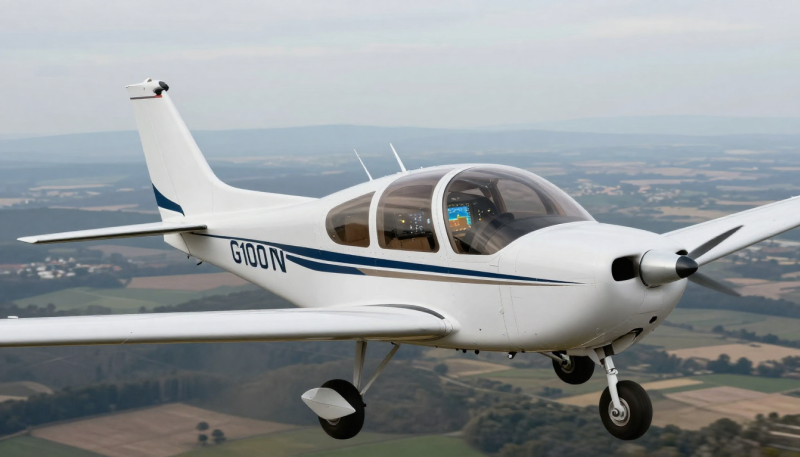
Modern versions use the Garmin G1000 NXi glass cockpit, which significantly simplifies navigation and enhances flight safety.
At the same time, the basic concept of the aircraft has hardly changed.
This is a rare case where the design idea has proven to be so successful that it remains relevant for decades.
Sources
- Jane’s All the World’s Aircraft - Jane’s Information Group
- Cessna 172 Skyhawk Information Manual - Textron Aviation
- General Aviation Aircraft Design - Cambridge University Press - 2013
- The Complete History of Cessna Aircraft - Specialty Press - 2017
- Pilot’s Handbook of Aeronautical Knowledge - Federal Aviation Administration - 2016
You might like

New megaprojects of the 21st century: why the Istanbul Canal and the Mirror Line city are being built
Large-scale infrastructure projects have always served as a kind of symbol of the era. Once, such symbols were the pyramids of Egypt, later - the Panama Canal...

Is the Boeing 777 really the safest airplane in the world?
Aviation is often perceived through simple formulas. There is the "fastest airplane," the "largest," the "longest-range." And, of course, it sounds especially in...

Become a pilot in a couple of months? 10 myths about aviation training
The topic of training to become a private aviation pilot has long been surrounded by established notions that are actively circulated by the advertising of flight schools and popular media...

An RV is not an apartment on wheels: debunking myths about mobile homes
There is a persistent romantic aura surrounding motorhomes. In the popular imagination, it symbolizes absolute freedom, mobile real estate, and almost a vehicle...

Can you build a bunker by yourself: what popular instructions simplify
The idea of "building a bunker with your own hands" today sounds less like a fantasy from movies and more like a quite practical project. The rise in anxiety, discussions about technogenic...