
Is the Boeing 777 really the safest airplane in the world?
Aviation is often perceived through simple formulas. There is the "fastest airplane," the "largest," the "longest-range." And, of course, the phrase "the safest airplane in the world" sounds particularly convincing. In popular culture, this title is often attributed to the Boeing 777 - one of the most famous long-haul airliners of modern times.
But what exactly lies behind this statement? Is it even possible to determine the "safest airplane"? And does the Boeing 777 truly deserve such a reputation?
In this material, we analyze the claims from the video and check their factual accuracy.
Is it even possible to determine the "safest airplane"?
“For an ordinary person, who does not delve into the intricacies of air transportation, the most reliable airplane is the one with the fewest accidents.”
This is a common logic, but in aviation, it is considered overly simplistic. The number of accidents alone says almost nothing about the safety of an aircraft.
The reason is simple: different models have different scales of operation. If one airplane makes millions of flights, while another makes tens of thousands, comparing them solely by the number of accidents is incorrect.
Therefore, aviation statistics use another metric — the accident rate per million flight hours or per million flights.
“This is the ratio of the number of air accidents to the total flight hours, and this is how all rankings are conducted.”
Such a methodology is indeed applied in the industry. It allows for consideration not only of the incidents themselves but also of the scale of aircraft operation.
However, it is important to understand: even this metric does not make one aircraft “absolutely safer” than others. Many factors influence the statistics:
- operating conditions
- crew training levels
- airline standards
- maintenance
- weather conditions and routes
In other words, aviation safety is a systemic result, not just the design of the aircraft.

Is it true that the Boeing 777 did not have any accidents for a long time?
“In 20 million flight hours, there has not been a single accident involving the ‘triple seven’.”
This statement is based on a real fact but requires clarification.
The Boeing 777 indeed had exceptionally good safety statistics in its early years of operation. The aircraft began commercial flights in 1995, and for a long time, there were no accidents resulting in fatalities.
However, later such events did occur. For example:
- the Asiana Airlines flight crash in San Francisco (2013)
- the disappearance of Malaysia Airlines flight MH370 (2014)
- the downing of Malaysia Airlines flight MH17 over Donbas (2014)
Some of these cases are not related to technical problems with the aircraft but rather to human factors or external circumstances. Nevertheless, they show that the wording “not a single accident” is only accurate for the early period of operation.
Therefore, it is more correct to say: The Boeing 777 maintained one of the best safety records among wide-body aircraft for a long time.
Why is the Boeing 777 considered technologically special?
“This is one of the first aircraft from the aerospace company Boeing equipped with a digital Fly by Wire control system.”
One of the key features of the Boeing 777 was the implementation of the fly-by-wire control system.
The essence of this technology is that the pilot's movements are transmitted not directly through mechanical linkages, but via electronic signals that are processed by computers.
This provides several advantages:
- reduced pilot workload
- automatic protection against dangerous flight modes
- increased control accuracy
- integration with stabilization systems
It is important, however, to note: Boeing adopted a hybrid control philosophy. Unlike Airbus, which uses side sticks, the Boeing 777 retained traditional yokes.
This decision was a compromise between new technologies and pilot habits.
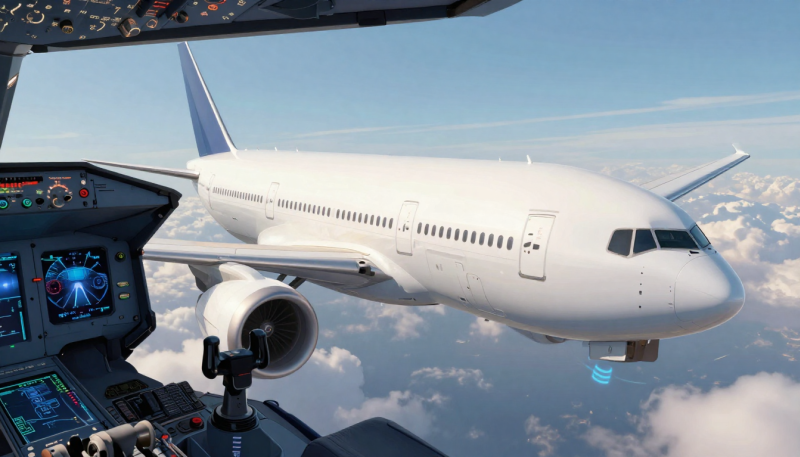

The first fully "digital" airplane Boeing
“Throughout the entire development process, not a single paper drawing was released.”
This statement is generally true and is considered one of the key technological breakthroughs of the Boeing 777 program.
The aircraft design was carried out using the CATIA system, a three-dimensional engineering platform developed by the French company Dassault.
As a result, Boeing was able for the first time to:
- create a complete digital model of the aircraft
- verify the spatial arrangement of parts before production
- reduce the number of manufacturing errors
In the aviation industry, this became an important milestone in the transition to digital design, which is now the standard.
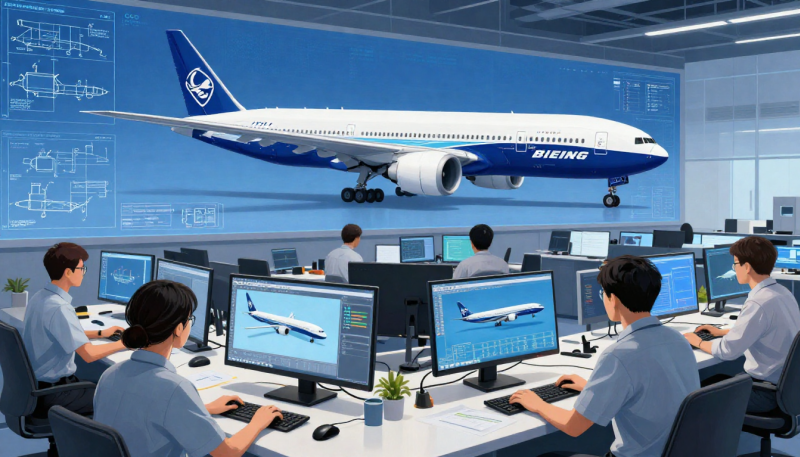
An unusual aircraft development model
“Eight major airlines participated in the design of the aircraft.”
This is another important feature of the Boeing 777 program.
The following airlines actively participated in the development:
- All Nippon Airways
- American Airlines
- British Airways
- Cathay Pacific
- Delta Air Lines
- Japan Airlines
- Qantas
- United Airlines
They formed the Working Together task force.
The essence of this initiative was simple: the airlines directly influenced the characteristics of the future aircraft.
As a result, Boeing received precise requirements for:
- cabin layout
- flight range
- fuel efficiency
- cockpit interface
This approach allowed for the creation of an aircraft that initially met market expectations.

Design solutions that impact safety
"The aircraft has three backup hydraulic systems, of which only one is needed for landing."
This is indeed an important part of the safety architecture of the Boeing 777.
In aviation, the principle of multiple redundancy is applied. If one system fails, its functions are taken over by others.
On the Boeing 777:
- three independent hydraulic systems
- multiple sources of electricity
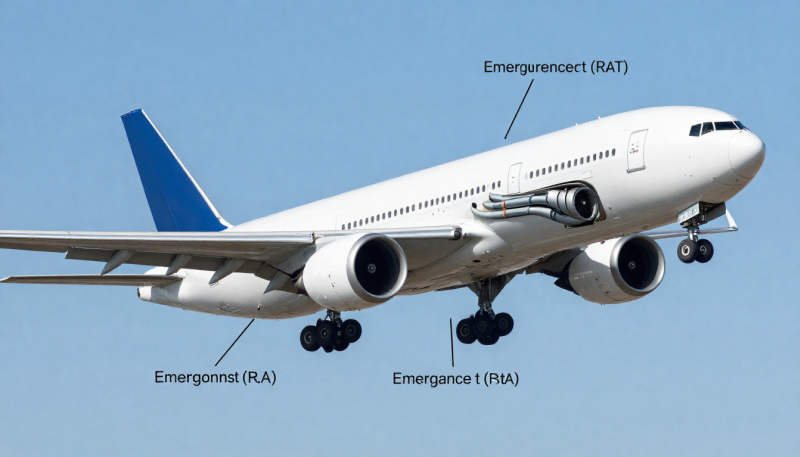
- emergency turbine (RAT)
"An emergency aviation turbine is located in the wing fairing — a small wind generator."
This turbine automatically deploys in the event of a complete power loss and provides:
- power to critical systems
- basic control of the aircraft
Such solutions are not unique to the 777 — they are also used in other modern airliners — but together they form a high level of fault tolerance.
Why the airplane became commercially successful
“The Boeing 777 has become the most profitable aircraft for the company.”
The Boeing 777 has indeed proven to be an extremely successful project.
Reasons for success:
- high fuel efficiency
- large capacity
- long range
- flexible cabin configuration
The aircraft can carry:
“from 305 to 550 passengers depending on the cabin configuration”
This allows airlines to adapt the aircraft to different business models: from premium routes to high-density transport.
Moreover, the 777 has proven particularly effective on long intercontinental routes, where fuel savings are crucial.
Development of the family: Boeing 777X
“Boeing has planned to release a new generation of airliners — the 777X.”
The Boeing 777X program is an evolution of the original aircraft.
The new versions feature:
- composite wings
- folding wingtips
- new GE9X engines
- improved aerodynamics
The main modifications are:
- 777-8
- 777-9
They are expected to compete with the Airbus A350.
However, the launch dates have been repeatedly postponed. The certification of the program turned out to be more complicated than anticipated, especially after the tightening of safety requirements in aviation.
Sources
Boeing 777 — one of the most reliable and technologically advanced long-haul aircraft in modern aviation, but not the "safest" in an absolute sense.
- Boeing 777 Airplane Characteristics - Boeing Commercial Airplanes
- Statistical Summary of Commercial Jet Airplane Accidents - Boeing
- Aircraft Accident and Incident Statistics - ICAO
- Aviation Safety Network Database - Flight Safety Foundation
- The Airliner World Fleet Book - Key Publishing
You might like

New megaprojects of the 21st century: why the Istanbul Canal and the Mirror Line city are being built
Large-scale infrastructure projects have always served as a kind of symbol of the era. Once, such symbols were the pyramids of Egypt, later - the Panama Canal...
The most mass-produced aircraft in history: why the Cessna 172 became an aviation legend
The history of aviation is usually associated with giants. People recall long-haul airliners, military aircraft, or supersonic projects. However, if...
Become a pilot in a couple of months? 10 myths about aviation training
The topic of training to become a private aviation pilot has long been surrounded by established notions that are actively circulated by the advertising of flight schools and popular media...

An RV is not an apartment on wheels: debunking myths about mobile homes
There is a persistent romantic aura surrounding motorhomes. In the popular imagination, it symbolizes absolute freedom, mobile real estate, and almost a vehicle...

Can you build a bunker by yourself: what popular instructions simplify
The idea of "building a bunker with your own hands" today sounds less like a fantasy from movies and more like a quite practical project. The rise in anxiety, discussions about technogenic...