
Can you build a bunker by yourself: what popular instructions simplify
The idea of "building a bunker with your own hands" today sounds less like a fantasy from movies and more like a rather mundane project. The rise in anxiety, discussions about technological accidents, military risks, and climate disasters have made the topic of private shelters a part of mass culture. On YouTube, in blogs, and in instructions, it is often claimed that a bunker can be built in the backyard quickly, cheaply, and without much difficulty.
But it is precisely in this simplicity that the problem lies. An underground shelter is not a shed or a greenhouse. It is an engineering structure that must withstand soil pressure, moisture, possible collapses, and provide ventilation and safety for people inside. A miscalculation here is measured not in spoiled repairs but in risks to life.
In this material, we will analyze key statements from a popular guide on DIY bunker construction and check how well they align with engineering, legal, and practical realities.
Myth #1. You can build a reliable bunker on your property without permits and formalities.
The initial logic is simple: if the land is privately owned and the utilities are not affected, no approvals are needed. In practice, the situation is significantly more complicated.
Firstly, in most countries, any capital underground structures are considered capital construction objects. Even if they are not visible from the outside, they may require:
- notification of the start of construction,
- approval from architectural control authorities,
- compliance with building codes and regulations,
- accounting in cadastral documentation.
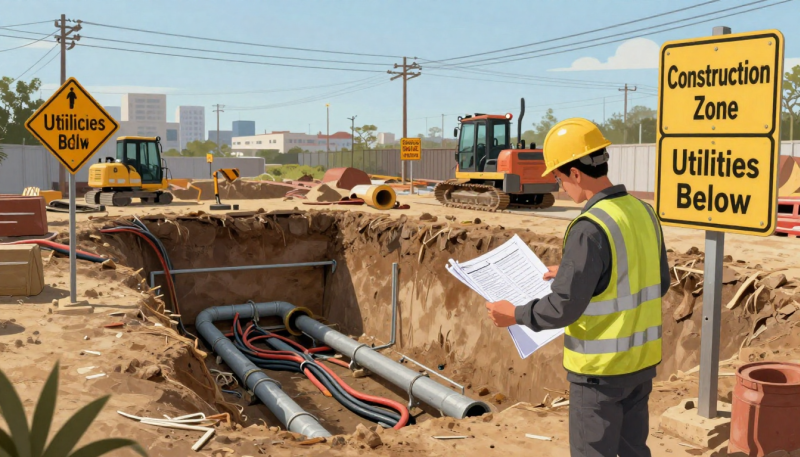
Secondly, the issue of utilities is not limited to pipes at depth. There are protection zones: for power lines, gas pipelines, water supply and sewage networks, underground communication cables. Violating such zones can lead to administrative or even criminal liability.
So the assertion of the simplicity of the legal side of the issue greatly oversimplifies reality.

Myth #2. It's enough to find out the groundwater level from a well - and it's safe to dig.
The material suggests orienting oneself to the water level in the neighboring well or the nearest body of water. This seems logical, but geology is rarely that linear.
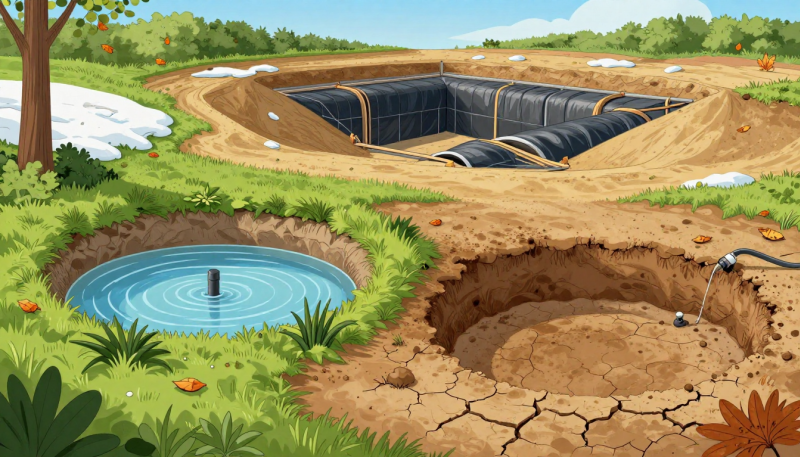
The depth of groundwater can vary significantly depending on the season. In spring, the level rises due to snowmelt, and in autumn, due to precipitation. The difference can be a meter or more. If one relies on the minimum water level, there is a risk that in six months the bunker will be partially flooded.
Moreover, the soil structure plays a critical role. Sandy soils quickly allow water to pass through, while clayey soils retain it, creating pressure on the walls. Without calculating drainage and waterproofing, even concrete of grade M-200 does not guarantee long-lasting protection. In industrial construction of underground structures, systems for water drainage, waterproofing membranes, and expansion joints are always incorporated.
Ignoring these factors turns the shelter into a potentially damp space with the risk of mold, corrosion, and gradual structural deterioration.
Myth #3. Bags of soil or old tires can replace full walls.
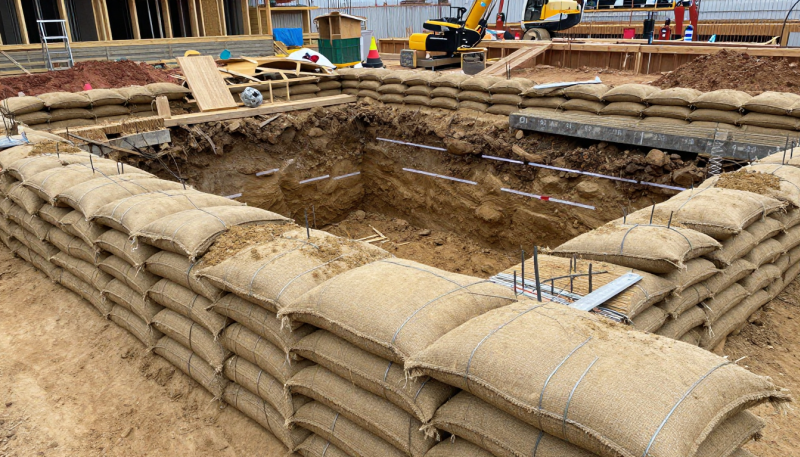
It is suggested to lay bags filled with soil, fastening them with wire, to form walls and even ceilings. This technology is indeed used - but in specific conditions and with a clear understanding of the loads.
Bags of earth are used in so-called earthbag construction. However, even in these projects, the wall thickness is calculated, reinforcement is used, and seismic loads are taken into account. For underground structures, a key parameter is the pressure of the soil on the walls. It increases proportionally with depth and soil density.
At a depth of 2-3 meters, the horizontal pressure can reach tens of kilopascals. Without a rigid frame and reinforcement, walls made of bags are susceptible to deformation. The ceiling remains particularly vulnerable - the load from above includes the weight of the soil, possible equipment, and snow.
Tires are indeed used in alternative construction, but more often in above-ground walls with additional reinforcement and moisture protection. In an underground environment, rubber ages, and the lack of a rigid load distribution scheme increases the risk of partial collapse.

Myth #4. A hermetic door and ventilation can be organized without special calculations.
Tightness is not just a snug fit of the door. In the context of a shelter, it means controlling the inflow and outflow of air, protection against smoke, toxic gases, or dust.
For one person, the minimum fresh air consumption is about 20-30 cubic meters per hour. For a family of four, this is already around 100 cubic meters. Without forced ventilation with filtration, carbon dioxide will accumulate, causing headaches, weakness, and decreased concentration.
Professional protective structures use filter-ventilation systems designed for air exchange rates. A homemade pipe with a damper can provide air inflow, but it does not guarantee filtration and uniform distribution.
An airtight door without a positive pressure system and air inflow control turns the room into a closed volume, where the main risk is not an external threat, but a lack of oxygen.

Myth #5. A bunker can be built with minimal costs.
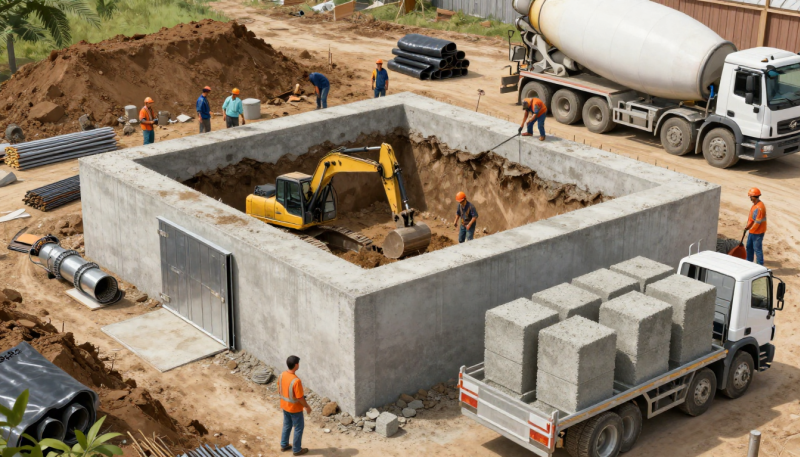
The idea of "minimum resources and effort" sounds appealing, but in real calculations, the figures change quickly. Even a small concrete bunker with an area of 10-12 square meters and a depth of 2-3 meters will require several cubic meters of concrete. One cubic meter of concrete weighs about 2.4 tons. For the foundation slab and walls, 8-12 cubic meters may be needed, not counting reinforcement, waterproofing, and delivery.
Let’s add the rental of an excavator or soil removal. An excavation volume of 30-40 cubic meters means tens of tons of earth. If it cannot be evenly distributed across the site, removal will be necessary.
Costs also include ventilation, a metal door, airtight hatches, pipes, a generator or batteries, and water storage systems. Even with a frugal approach, the final amount rarely stays within "several tens of thousands." In practice, it can be hundreds of thousands of rubles.
Minimizing expenses is only possible by simplifying the design, but then the level of protection decreases.
Myth #6. If the bunker is camouflaged, it is automatically safe.
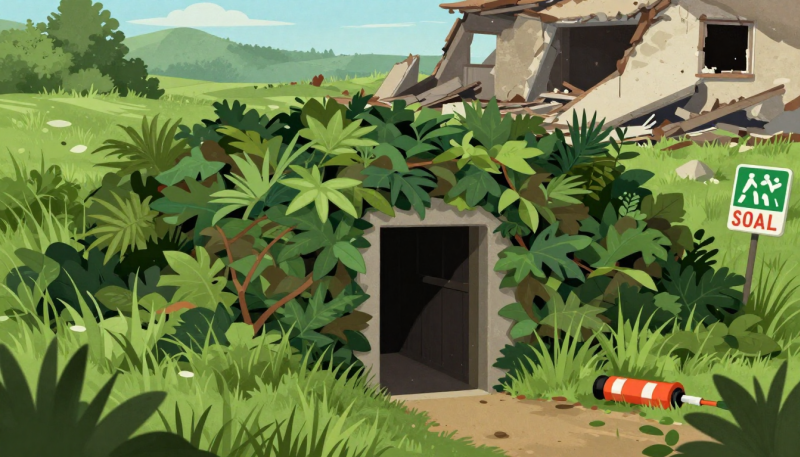
It is suggested to conceal the entrance with decorative shrubs, grass, or landscaping elements. Camouflage does indeed reduce visual visibility. However, safety is determined not only by how difficult it is to find the entrance.
During emergencies, the key risk is not the curiosity of neighbors, but physical impacts: soil collapse, fire, flooding, mechanical damage. If a building collapses nearby, the shockwave or debris can damage ventilation pipes and ceilings regardless of whether the hatch is visible from the outside.
Moreover, a completely concealed entrance complicates evacuation for rescuers. Civil defense regulations provide for the marking and accessibility of protective structures. Complete invisibility can work against the owner in the event of a real emergency.
Camouflage is a tactical element, but it does not replace engineering resilience.
Myth №7. A stock of water and canned goods solves the problem of long-term living.
The material mentions a water supply of 200-300 liters and canned products. This may be sufficient for short-term shelter. However, when calculating for a family of four, 300 liters of water is approximately 3-4 days at a minimum rate of 2-3 liters of drinking water per person per day, not accounting for hygiene and cooking.
For two weeks of autonomous living, at least 250-300 liters will be needed just for drinking. If sanitary needs are taken into account, the volume increases significantly.
Food storage is a separate challenge. Canned goods have a shelf life and require rotation. Grains and dry products need protection from moisture and rodents. Finally, prolonged confinement creates psychological stress. Studies on human behavior in isolation, including research on modeling enclosed environments, note an increase in anxiety and conflict in the absence of natural light and adequate space.
Autonomy is not just a food supply, but a comprehensive life support system.

Myth #8. A homemade bunker will provide protection from any disaster.
In popular perception, a bunker is universal - it will protect against war, technological accidents, and natural disasters. In practice, each threat needs to be considered separately.
Protection against tornadoes requires reinforced ceilings and calculations for impact loads. Protection against radiation requires sufficient thickness of soil or concrete - to significantly reduce gamma radiation, dozens of centimeters of dense material are necessary. Protection against chemical contamination is impossible without filters with appropriate cartridges.
A universal solution requires complex engineering calculations and specialized equipment. A homemade structure without design may reduce certain risks, but it does not automatically become protection against the entire spectrum of threats.
A bunker is a tool, the effectiveness of which depends on the specific task it is designed for.
Sources
Building an underground space by hand is possible. However, there is a significant engineering gap between a "subterranean room" and a "reliable survival bunker." Without load calculations, waterproofing, ventilation, and legal assessment, such a project remains vulnerable.
If the idea is considered as a temporary shelter for a few hours or days, it may be feasible. However, if it involves prolonged autonomous living, the level of complexity and costs turns out to be significantly higher than usually assumed.
- Alexander, D. E. "Building Codes and Disaster Risk Reduction". International Journal of Disaster Risk Reduction, 2013.
- FEMA. "Safe Rooms for Tornadoes and Hurricanes: Guidance for Community and Residential Safe Rooms", FEMA P-361.
- US Army Corps of Engineers. "Protective Design Center Technical Reports".
- Coduto, D. P. "Foundation Design: Principles and Practices". Pearson Education.
- Das, B. M. "Principles of Geotechnical Engineering". Cengage Learning.
- FEMA P-320 Taking Shelter from the Storm: Building a Safe Room for Your Home or Small Business. Federal Emergency Management Agency, 2014.
- Easton D. The Earthbag Building Guide. Chelsea Green Publishing, 2007.
You might like

New megaprojects of the 21st century: why the Istanbul Canal and the Mirror Line city are being built
Large-scale infrastructure projects have always served as a kind of symbol of the era. Once, such symbols were the pyramids of Egypt, later - the Panama Canal...

The most mass-produced aircraft in history: why the Cessna 172 became an aviation legend
The history of aviation is usually associated with giants. People recall long-haul airliners, military aircraft, or supersonic projects. However, if...

Is the Boeing 777 really the safest airplane in the world?
Aviation is often perceived through simple formulas. There is the "fastest airplane," the "largest," the "longest-range." And, of course, it sounds especially in...

Become a pilot in a couple of months? 10 myths about aviation training
The topic of training to become a private aviation pilot has long been surrounded by established notions that are actively circulated by the advertising of flight schools and popular media...

An RV is not an apartment on wheels: debunking myths about mobile homes
There is a persistent romantic aura surrounding motorhomes. In the popular imagination, it symbolizes absolute freedom, mobile real estate, and almost a vehicle...