
The Fastest Production Cars in the World
The permissible speed for driving on federal highways usually does not exceed the mark of 110 km/h. However, there are cars that can accelerate to speeds 4 times greater - they are called hypercars. 400, 450, 500 km/h. What are they for, and who drives them? Let's take a look.
The first in history
15 years ago, the word "hypercar" referred to only one specific car, the capabilities of which challenged the laws of physics and human imagination. This is about the McLaren F1 model.
The history of this unique machine began back in 1988. It was then that designer Gordon Murray and designer Peter Stevens presented the first sketches of the "super sports" coupe to Ron Dennis, the boss of McLaren. The car was to become the street embodiment of the company's success in Formula 1. The first prototype was ready by mid-1991. And in 1994, the car reached customers. Thus, a legend was born, and it became a long-time "holder" of the prestigious title of the fastest production car in the world.
The F1 was built primarily with the consideration of the minimum possible weight - it was supposed to weigh no more than 1,000 kilograms. For the first time, unique ultra-strong yet lightweight materials were used for a road car. In the McLaren, you won't find power steering, brake assistance, or traction control systems — Murray deemed all of this unnecessary. The black interior only had space for an audio system, air conditioning, and 2 passenger seats.
The pride of the English company is powered by an engine from German BMW, developing 627 horsepower. To absorb heat, the engine is coated with gold foil from the inside. Each unit of the F1 contains about 25 grams of this highly valued metal.
The car accelerates to an impressive 390 km/h, reaching 100 km/h in just over three seconds. The first 10 of the 64 existing units, which at that time cost a record 1.2 million dollars, were sold on the day of the presentation during a pre-sale!
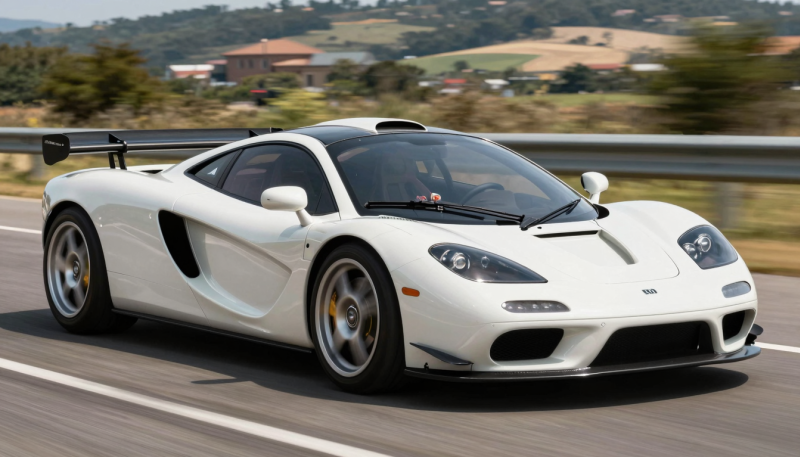

Car with a speed key
After several years, in 1997, a new sketch was being created on the express train between Tokyo and Nagoya, destined to once again change the automotive world. At that time, the talented engineer, long-time CEO and chairman of Volkswagen Group Ferdinand Piëch drew a powerful, robust engine with 18 cylinders on an envelope - a true engineering innovation.
The only thing left was to choose the right car brand. Piëch was deciding between Bentley and Rolls-Royce, but suddenly a good idea was suggested by his five-year-old son, who was begging his father to buy him a toy Bugatti. And already in 1998, the Volkswagen Group acquired this company.
First of all, at least 4 prototypes of the new model were produced. The most successful - Bugatti EB 18.4 Veyron appeared in 1999 at the Tokyo Motor Show. It was then announced that a production unit with a power of 1001 horsepower, capable of speeds over 400 km/h, was being developed, which raised doubts among critics, but ultimately became a reality.
The new Bugatti Veyron could reach a speed of 375 km/h under normal conditions, accelerating to 100 km/h in 2.7 seconds. However, to achieve the maximum possible speed of 407 km/h, a second key - the "Speed Key" - must be inserted into an additional lock next to the driver's seat. When turned, the ground clearance is reduced to 6.35 cm, the spoiler angle decreases to 2 degrees, the diffuser on the front grille closes, and the steering angle is limited.
Starting from 2005, at least 400 units of this car were sold, with a starting price of $1,700,000. Additionally, to boost sales, Bugatti often uses special versions of its model, of which at least thirty-four have been produced since the first presentation of the Veyron.
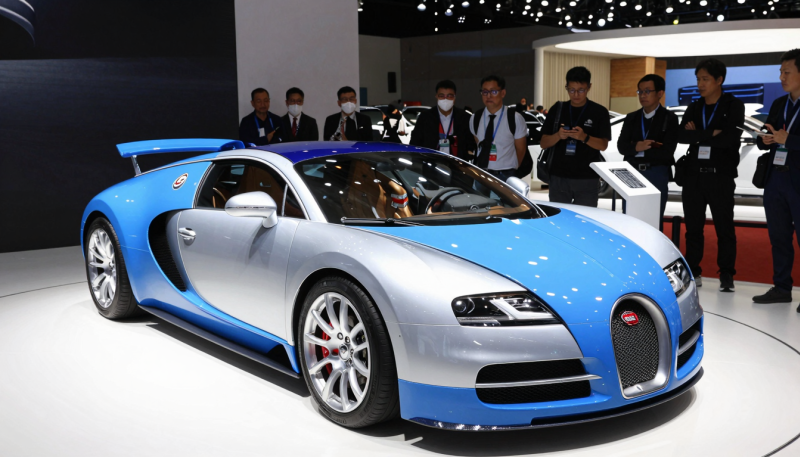
New Bugatti
Already in 2010, the upgraded version of the previous car set a new record. Germany, the secret testing ground of Volkswagen AG. Test driver Pierre-Henri Raphanel takes to the 20-kilometer oval. He drives the 1200-horsepower Bugatti Veyron Super Sport. First — from south to north. With tires screeching, the hypercar reaches a peak speed of 427.933 km/h. The second attempt — a run in the opposite direction. Measuring instruments record 434.211 km/h. In the end, representatives of the Guinness World Records register the average result of the two runs — 431.072 km/h. This is a new speed record for production road cars.
And although the officially permitted speed is limited to 415 km/h in mass production (it is restricted by electronics to preserve the tires), this car can truly be called one of the fastest in the world.
Despite the fact that the Bugatti Veyron Super Sport is quite an "old" hypercar, it more than deserves its place on our list, as this version was the one that raised the bar for all competitors in the market. To achieve such results, engineers had to solve numerous technological challenges that left a mark in the history of automotive engineering. Elegant, stylish, and truly unique, the Bugatti Veyron is guaranteed to hold its place in history for a long time.
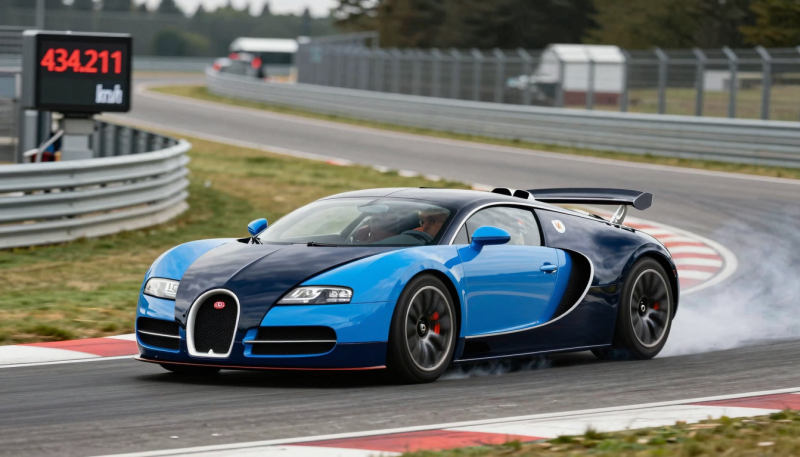

Hennessey Venom GT
Let's take a look at cars from other manufacturers. Yes, Bugatti models are great, but they are not the only hypercars that exist.
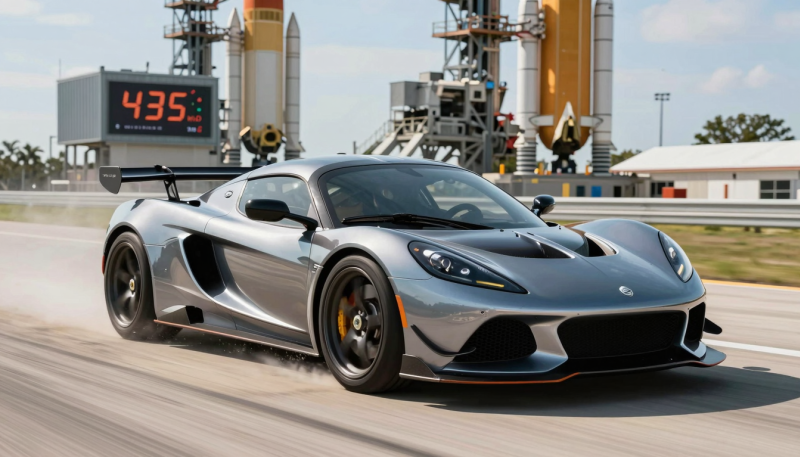
In 2014, Americans accelerated the Hennessey Venom GT coupe to 435.31 km/h. During testing, it reached a speed from 0 to 100 km/h in just 3.05 seconds. But let's go in order.
At the core of this car is the relatively modest Lotus Elise/Exige. Originally, these miniature English roadsters and coupes were designed for engines with less than 200 hp. However, it turned out that the potential of this platform is simply limitless. The Lotus company itself has been installing increasingly powerful engines every year, reaching 430 hp at present. But the American company Hennessey Performance Engineering managed to establish a limited production of cars with three times the power!
The wheelbase had to be stretched by half a meter, the body width increased by 24 cm, and otherwise, we have the same small Elise, renamed to Venom GT. Only behind the driver and passenger are more than 1200 hp. And that was enough to compete with Bugatti. After all, although the Venom GT lags in power, it has a significant advantage in weight. This is Lotus's signature trump card: thanks to the aluminum frame and plastic body, the base roadster weighs less than a ton. The Venom has certainly gained weight, but compared to the Veyron, it is like a compact hatchback compared to a large crossover. Bugatti weighs about 1.9 tons, while Hennessey weighs 1.25 tons.
The Venom GT demonstrated its "maximum speed" at the spaceport in Florida in 2014. However, this was not recognized as a world record. Firstly, records are only recorded for models produced in a minimum batch of 30 units, and Hennessey has created only seven coupes and six roadsters over the years. Secondly, to establish a world record, two runs must be made in opposite directions, and the average achievement is counted. The Venom GT only made that run once at that speed.
However, it did set another world record (recognized by Guinness as well). In 2013, it became the fastest car in the world to accelerate from 0 to 300 km/h. It took just 13.63 seconds to achieve this.
Koenigsegg Agera RS
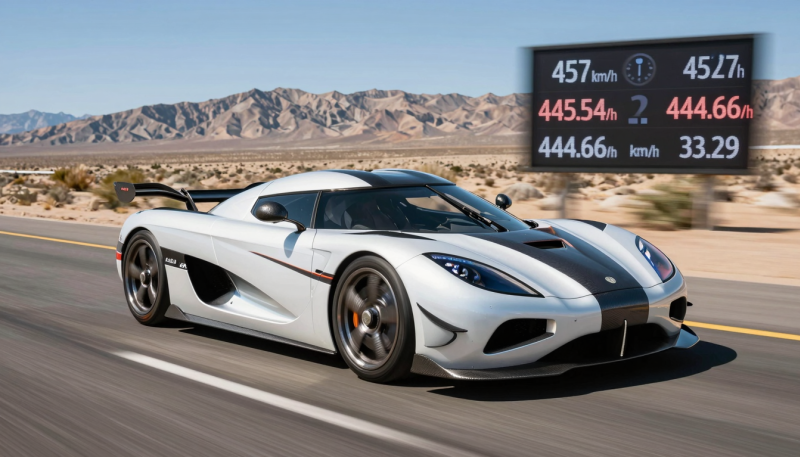
Later, another manufacturer made a statement about itself. In 2017, the hypercar Koenigsegg Agera RS set several world records in one day, including the absolute speed record for production cars — 447 km/h. In these runs, unlike the Hennessey record, everything was conducted under strict rules — in both directions. In one of them, the speed even reached 457 km/h. Interestingly, the runs were organized on a regular highway in Nevada, which was, of course, closed for the occasion. This allowed for new records on public roads: one kilometer at a speed of 445.54 km/h and one mile at a speed of 444.66 km/h. Another impressive record was the acceleration and stop from 0–400–0 km/h. The Koenigsegg Agera RS achieved this in just 33.29 seconds.
The fantastic performance of this hypercar is due to the fact that it combines lightness, almost like the Venom GT, with power approaching that of Bugatti. It is also worthy of respect that the Swedish company Koenigsegg does everything itself, without the help of powerful corporations and without using foreign chassis and body elements. The Agera has both an engine of its own design and a body of its own manufacture. Moreover, the design was personally handled by the founder and CEO of the brand — Christian von Koenigsegg.
Racing cars
And before we tell you about the fastest road cars, we would like to show you some other quite unusual speed machines.
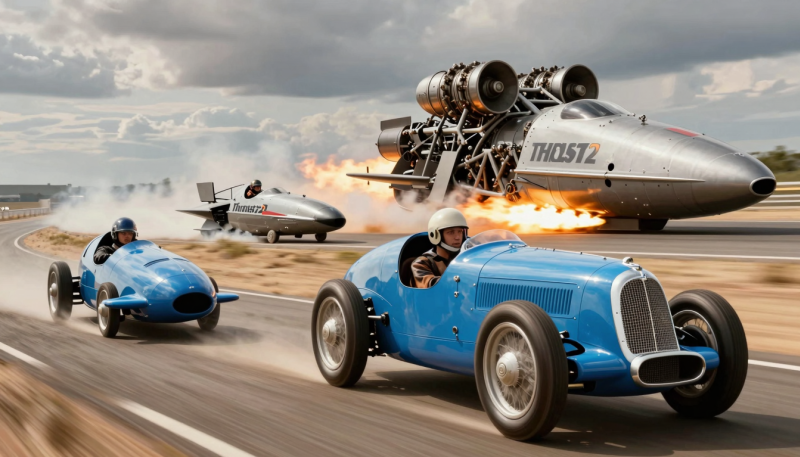
You will surely be surprised to learn that as early as 1933, a model capable of reaching speeds over 480 km/h was introduced. The unique Blue Bird was created by Malcolm Campbell. The sports car had a rather unusual shape, a powerful engine, and several records to its name. But that was almost a hundred years ago. What can more modern racing cars do?
"The Blue Flame" is the world's first land vehicle that managed to reach a speed of over 1,000 km/h. The length of this "rocket" is 12 meters, its weight is about 3 tons, and the thrust of the rocket engine is approximately 100,000 newtons. The car has 2 rear wheels and 1 double front wheel, so it is considered a four-wheeled vehicle rather than a three-wheeled one, as it may seem at first glance. In 1970, this car allowed driver Gary Gabelich to set a world speed record of 1,014.3 km/h. An absolute leader of that time.
But then the "Thrust2" from Britain, with its incredibly powerful turbine engine, broke the previous record. It looked more like a super-fast locomotive than a rocket. It was equipped with the famous Rolls-Royce Avon engine. This time, the speed achieved by the car was 1,047.5 km/h. The record was broken - but the sound barrier was not surpassed, and the engineers continued their work.
And so, hard work led to the creation of the next monster. Two Rolls-Royce Spey turbine engines, with a total power of 110,000 horsepower. Length - 17 meters, width - 4. Weight - almost 11 tons. In one second, such a machine burns 18 liters of fuel. The "Thrust SSC" in 1997 managed to accelerate in 30 seconds to a speed of 1,228 km/h, thus becoming the first car in the world to break the sound barrier. This world record has not been beaten to this day. A well-deserved first place.
Road Record Holder
Let's return to our main top. Here, at least 2 cars are competing for the title of the fastest of the fast.
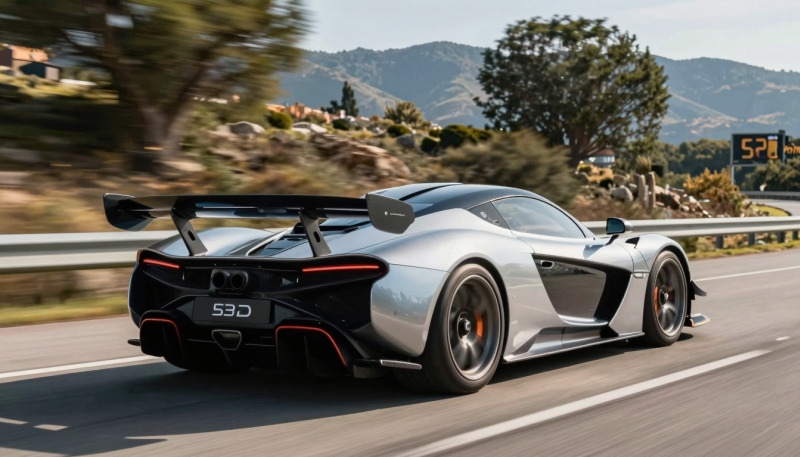
SSC Tuatara – the most powerful car currently in existence in the world. Its manufacturer is the well-known American company Shelby Super Cars. In early 2011, the first public presentation of this model took place in Shanghai. The new gasoline hypercar Tuatara broke the previous speed record and managed to accelerate to 532 km/h on a public road.
The car is named after the tuatara – a relict lizard native to New Zealand. The word "tuatara" is used by the indigenous people – in the Maori language, it means "spines on the back." This description fits the hypercar's appearance: behind the doors, it has a pair of small wings, and at the rear, there are a pair of aerodynamic fins.
Future record holder. Or not?
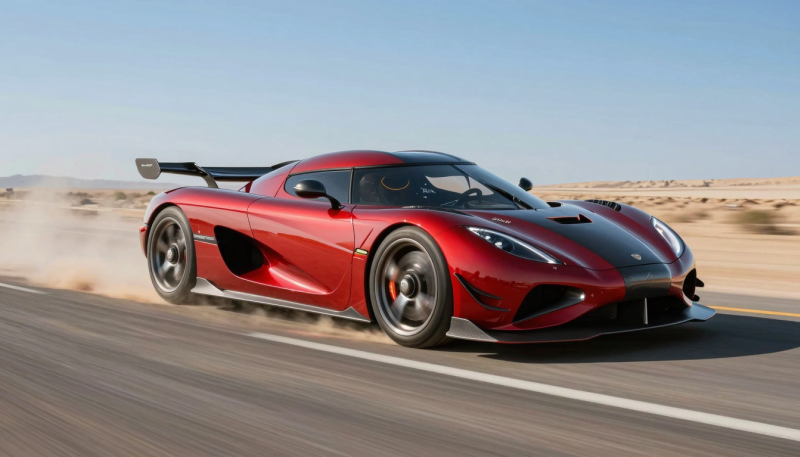
Recently, Koenigsegg announced that it plans to break the world speed record for production road cars once again. The Swedish hypercar manufacturer aims to achieve this with its latest development, the Jesko Absolut: theoretically, the maximum speed of this model exceeds 530 km/h.
Moreover, Koenigsegg believes that the title of the manufacturer of the fastest production car still belongs to them, despite claims from SSC. Recall that back in 2017, the Koenigsegg Agera RS demonstrated an average speed of 447 km/h over two runs.
So why doesn't the Swedish manufacturer acknowledge the achievements of its competitors? The fact is that many people who watched the video capturing the new Tuatara record had doubts. A blogger provided a detailed analysis of the video, pointing out the discrepancy between the car's speed and what is necessary to cover that distance. Later, SSC countered with a statement that the actual speed of the Tuatara was confirmed by the GPS device manufacturer Dewetron, whose equipment was used in the run. However, this company subsequently denied the information — its employees were not present at the tests and did not participate in the preparation. And since the data is largely based on the proper calibration of the equipment, Dewetron cannot guarantee its accuracy.
Representatives of SSC promised a new run of the Tuatara that would confirm the model's claim to the title of "fastest road car." However, since 2020, those promises have not been fulfilled. Meanwhile, for the Koenigsegg Jesko Absolut, a new special aerodynamic package and an engine capable of producing up to 1622 hp have been developed. Testing of the production cars is not yet complete, but the company's announcement of plans for a world record may indicate that they are nearing completion.
You might like
Crazy car stunts that are hard to believe!
In this video, a truck with a trailer will jump 25 meters; you will see how the Nürburgring is driven on two wheels; we will show a loop-the-loop in a car and many ...

Is it true that Putin has 50,000 bodyguards? Who really protects world leaders?
The conversation about the personal protection of world leaders is almost always accompanied by strong exaggerations. In popular culture, bodyguards are perceived as ...

How North Korea Really Works: 11 Popular Misconceptions
North Korea has long become an object of mythologization. Some see it as an exotic archaic regime, others as almost a dystopia from a textbook on total...

10 unusual professions that turned out to be not so unusual after all
In almost every popular video about unusual professions, viewers are invited to be amazed: here are people milking snakes, hiring huggers, or staging kidnappings...

Carandiru: How Brazil's Largest Prison Became a Symbol of Systemic Violence
Prisons are rarely associated with humanism. But sometimes in the public consciousness, an image of the "most terrible prison in the world" emerges - a place where punishment prev...