
10 unusual professions that turned out to be not so unusual after all
In almost every popular video about unusual professions, viewers are invited to be amazed: here are people milking snakes, hiring huggers, or staging kidnappings. Such content relies on the element of surprise and easily gathers views. However, if we consider it as a factual statement about reality, another question arises - how accurate, typical, and correctly presented are these stories.
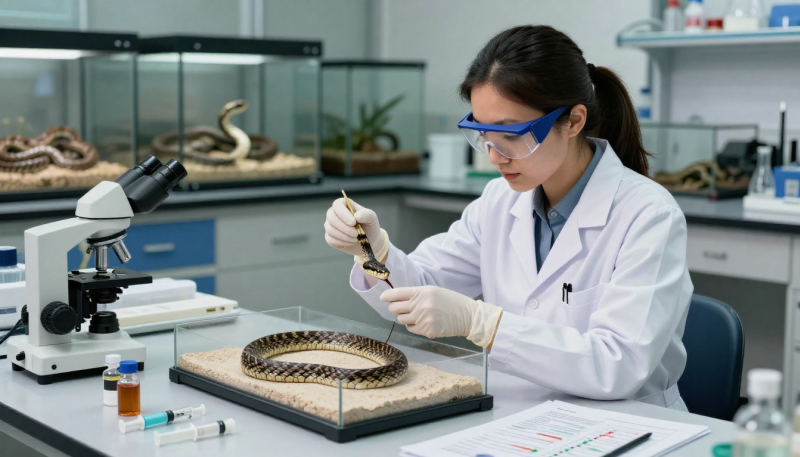
Myth #1. Snake milker is an exotic profession with a high salary and a medical miracle effect.
It is claimed that a venom extraction specialist can earn up to 60,000 dollars a year, and the venom itself is actively used for the prevention of strokes, heart attacks, and thrombosis. The basis is a real fact: there is a profession related to the extraction of snake venom, most often in serpentariums or pharmaceutical laboratories. Indeed, such specialists usually have an education in biology or herpetology.
However, there are several clarifications.
Firstly, this is not a mass or separate "dream profession," but a narrow specialization within toxicology, pharmacology, or zoology. More often, it refers to employees of research centers or antidote production facilities.
Secondly, the salary greatly depends on the country, level of qualification, and type of institution. The stated figure is possible in the USA, but it is not a universal standard.
Thirdly, snake venom is indeed used in medicine. Based on it, medications for treating hypertension have been developed - for example, captopril was created thanks to research on the Brazilian pit viper. But the claim about "the prevention of strokes and heart attacks" sounds generalized. Venom is not used directly as a universal remedy; specific isolated molecules are used after extensive clinical research.
In other words, the foundation is real, but the presentation creates the impression of a simpler and more romanticized process than it is in practice.

Myth №2. The chamberlain of the throne is an influential court figure, almost a gray cardinal to the monarch.
The story of a courtier accompanying the monarch to the toilet indeed has a historical basis. In England, there was the position of Groom of the Stool at the Tudor court. The first known holder of this post served under Henry VIII.
However, it is important to understand the context of the era. In the 16th-17th centuries, access to the monarch's body meant access to informal influence. This was a time when personal closeness to the ruler had political significance. Gradually, the position transformed and over time became more formal.
The phrase that the chamberlain "held considerable influence" is partially true for certain periods. But this is not a universal rule and not a constant status. Influence depended on the specific personality, political situation, and court structure.
Moreover, the very function of accompaniment was not reduced to a mundane detail emphasized by the scenario. Over time, the position became part of the financial management of the monarch's personal expenses.
Here, the effect of contrast works: intimate function + high status. But the historical reality is more complex and less anecdotal.

Myth #3. Professional kidnappers are a popular and legal entertainment industry
The scenario describes companies that stage kidnappings at corporate events, claiming that this has "quite a large popularity."
Indeed, such services exist in the format of extreme quests or pranks. However, it is incorrect to speak of a developed mass industry. These are niche services, often with serious legal restrictions.
The main factor here is the consent of the participants. Without clear prior agreement, such an event can easily become grounds for a lawsuit. In a number of countries, even the staging of violence in public spaces can lead to police intervention.
Thus, the profession as a stable category of employment appears exaggerated. More often, it is project-based activity in the field of event agencies or theatrical shows.


Myth #4. Up to 14,000 bicycles are retrieved from the canals in Amsterdam each year.
The number 14000 sounds impressive. And in this case, it is close to reality. The municipal services of Amsterdam indeed retrieve thousands of bicycles from the canals every year. In different years, the figures have ranged from 12000 to 15000.
But it is important to clarify two points.
First, this is not solely the result of "the legalization of drugs and strong beer," as the script suggests. The main reasons are theft, the disposal of old bicycles, and plain vandalism.
Second, this work is carried out by municipal service employees, not representatives of a separate romantic profession. It is part of the city's infrastructure for cleaning water bodies.
Here, the myth does not work to distort the fact, but to create an image of a chaotic city where bicycles are mass-dropped into the canals due to the irresponsible behavior of residents.

Myth #5. A legal bank robber can hack the system more than 1,000 times and never be caught.
The story of Jim Stickley, who allegedly committed over 1,000 "bank robberies" since 1992, is presented as a sensation.
In reality, there is a field called penetration testing. Security specialists simulate attacks to identify vulnerabilities. This is an entirely legal and in-demand practice in the field of cybersecurity.
However, the phrasing about "a thousand robberies" and "never being caught" serves as dramatization. Such tests are conducted under contract, with written permission from management. The lack of exposure is not a sign of genius, but a result of pre-agreed test conditions.
Moreover, the claim about stealing credit card numbers during testing sounds oversimplified. Usually, it involves simulating access, rather than actually circulating confidential data.

Myth #6. A living scarecrow is a stable and profitable alternative to regular work.
The scenario presents the story of a Brit, Jamie Fox, who allegedly works as a "living scarecrow" and earns about 300 dollars a week. The basis of the story is real: a few years ago, British media indeed reported on a farmer who hired someone to scare away birds.
But it is important to understand the scale of the phenomenon. This was a one-off contract, more of a PR story than the formation of a new profession. The farmer used an unconventional solution for a specific problem with partridges in a canola field. There is no market for "living scarecrows" as an industry.
300 dollars a week is not an indicator of attractive employment, but rather payment for seasonal work. In the agricultural sector, such temporary roles arise regularly - from seasonal harvesters to field observers. In this case, the job simply received an unusual media packaging.
What we have here is not a new profession, but an episode turned into a universal example.

Myth #7. Hugger is a mass and well-paid profession of the future.
The text states that the average client is willing to pay around $60 for a session of non-intimate cuddling. Platforms like Cuddlist do exist. This is part of the so-called cuddle therapy - a practice of platonic tactile contact.
But there are several nuances here.
Firstly, it is not a recognized medical profession, but a form of private service, often balancing between psychological support and the realm of body practices.
Secondly, income is unstable and heavily depends on the city and the personal brand of the specialist. Most practitioners consider it as a side job.
Thirdly, the market scale is limited. It is a niche segment aimed at a specific audience, not a new mass sector of the economy.
The fact of the service's existence is real. The perception of it as a full-fledged and widely spread profession is exaggerated.

Myth #8. A duck trainer at a hotel is an example of an exotic profession that exists for whimsy.
The story of the duck trainer at the Peabody Hotel in Memphis is also based on reality. The hotel indeed has a tradition of the daily "duck march" to the fountain.
But this is not a separate industry and not a typical profession. It is part of the marketing strategy of a specific hotel, a historical brand ritual embedded in the hotel service.
The employee who performs the role of "duck master" usually combines it with other duties. It is an element of the show program, not an autonomous specialty that is widespread beyond a single establishment.
Here, the profession is essentially created for the sake of a tourist image. It is a corporate role, not a market category of labor.

Myth #9. Underwater pizza delivery person is a real in-demand job
The plot of delivering pizza to an underwater hotel in Florida sounds particularly cinematic. And indeed, such delivery was practiced at Jules Undersea Lodge.
But it's important to clarify: this is not an independent profession. We are talking about a diving instructor who, as part of additional duties, delivered orders to guests.
There is no market for underwater couriers. This is a unique service in a one-of-a-kind accommodation. The economic logic is simple - creating an impression for clients paying hundreds of dollars per night.
The media format turns a marketing move into the illusion of a new profession.

Myth #10. A professional mourner - a stable international career
Professional mourners do exist in a number of cultures, especially in traditional societies in Asia and Africa. In China, this practice has been documented and studied by ethnographers.
However, it is important to understand: this is a cultural ritual, not a modern global profession with a growing demand in the West. In some regions, such practices are even restricted by the state as a manifestation of "excessive display."
Mentioning individual actors who have worked as mourners does not make this a widespread career path.
We are looking at a cultural tradition that exists in a specific context, not a universal niche in the service market.

Sources
If we bring all the discussed cases together, a common rule emerges: almost every "shocking profession" has a real basis. However, the emphasis shifts in the presentation - from a complex institutional or historical practice to a sensational anecdote.
In most cases, the myth lies not in the fact of the profession's existence, but in the scale, universality, and interpretation of its significance. Reality turns out to be less sensational but more interesting.
- McDowell R. The English Royal Household 1066-1939. Routledge.
- Stark R, Angulo A. Snake venom and antihypertensive drug development. Journal of Clinical Investigation.
- Municipality of Amsterdam. Waternet annual reports on canal cleaning.
- Weidman S. Penetration Testing and Network Defense. Cisco Press.
- Kohn G. Encyclopedia of Plague and Pestilence - entries on professional mourning traditions.

You might like

The Fastest Production Cars in the World
The permissible speed for driving on federal highways generally does not exceed the mark of 110 km/h. However, there are cars that are capable of...

Crazy car stunts that are hard to believe!
In this video, a truck with a trailer will jump 25 meters; you will see how the Nürburgring is driven on two wheels; we will show a loop-the-loop in a car and many ...

Is it true that Putin has 50,000 bodyguards? Who really protects world leaders?
The conversation about the personal protection of world leaders is almost always accompanied by strong exaggerations. In popular culture, bodyguards are perceived as ...

How North Korea Really Works: 11 Popular Misconceptions
North Korea has long become an object of mythologization. Some see it as an exotic archaic regime, others as almost a dystopia from a textbook on total...

Carandiru: How Brazil's Largest Prison Became a Symbol of Systemic Violence
Prisons are rarely associated with humanism. But sometimes in the public consciousness, an image of the "most terrible prison in the world" emerges - a place where punishment prev...