
The strangest Guinness records: how the absurdity industry is organized
When we hear about the Guinness World Records, our imagination often conjures up a set of absurd achievements: people eating airplanes, bodies covered in a million bees, marshmallow flights from nose to mouth. It creates a sense of a chaotic circus of human oddities.
But behind this facade lies an institution with clear verification rules, a history of commercial success, and a well-thought-out selection system. It is important to understand: is the strangeness of the records a side effect, a marketing strategy, or a reflection of the cultural mechanisms of modern society?
Myth #1. The Guinness World Records was originally created as a collection of oddities.
The history of the project's emergence has nothing to do with a show of eccentricity.
On May 4, 1951, Sir Hugh Beaver, managing director of Guinness Brewery, was participating in a hunt in County Wexford, Ireland. A dispute arose over the fastest game in Europe. Beaver discovered that there was simply no authoritative reference book to resolve such discussions.
The idea for the book was born as a tool for fact-checking contentious claims.
The first edition was published on August 27, 1955. It contained 197 pages and became a bestseller in the UK by Christmas. Later, the project transformed into an international publishing brand with sales of over 400 million copies.
Initially, the book served as a fact reference guide. However, over time, the audience's attention shifted from comparative statistical records to visually impressive and unusual achievements. This was not a random drift, but rather the logic of the market: the unusual sells better.
Strangeness became a tool for popularity, but not the original concept.

Myth #2. Any absurdity automatically makes it into the book.
The selection features records such as:
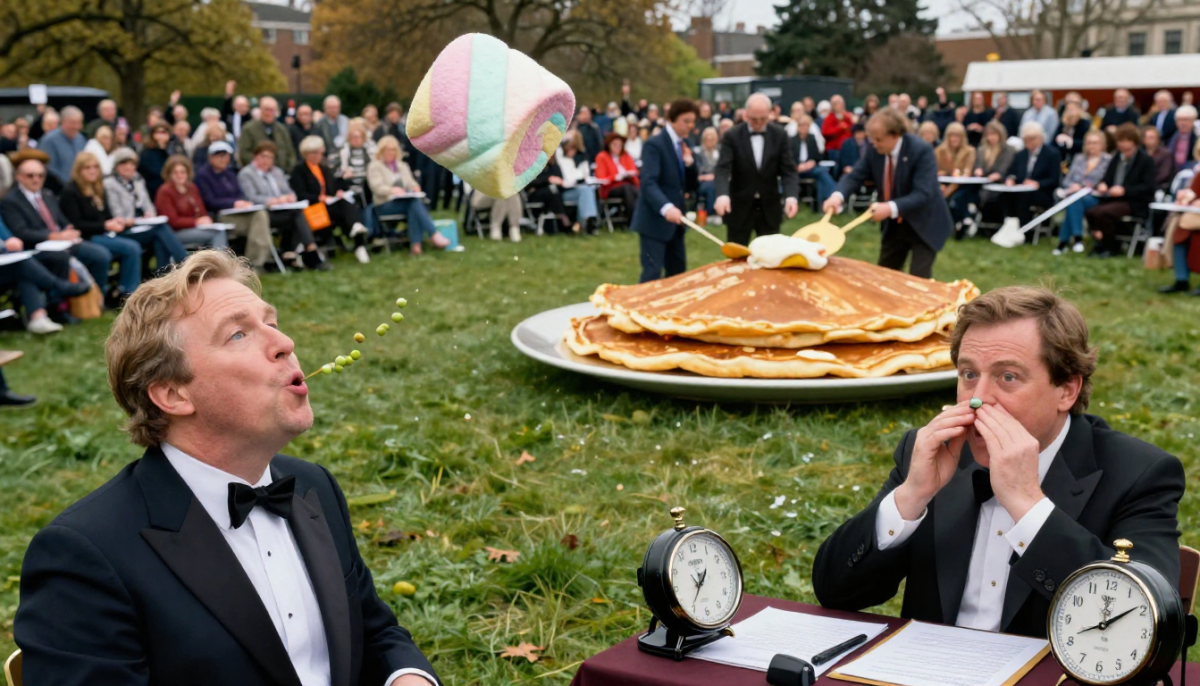
- blowing a pea 7.51 meters by Andre Ortolf
- flying a marshmallow 5.46 meters during a TV show in Los Angeles
- typing 103 characters with the nose in 47 seconds by Mohammed Hussein Kurshid
- mass pancake flipping by 890 participants in Sheffield
At first glance, this looks like an arbitrary collection of meaningless actions. However, Guinness World Records has a strict registration procedure: witnesses are required, documentation, technical recording of parameters, compliance with category, and no repetition of existing records without improving the result.
Absurdity does not negate the measurement standard. On the contrary, the stranger the achievement, the more important the clear methodology. That is why the record for mass pancake flipping counted only 890 out of 930 participants - 40 people were disqualified for breaking the rules.
The system remains formal even when the object of measurement seems ridiculous.
Myth #3. All records are safe and harmless.
Some achievements are on the edge of physiological possibilities.
Chinese beekeeper Gao Binge in 2015 covered his body with approximately 1.1 million bees weighing a total of 109 kg. He received over 2000 stings.
Michel Lotito, known as Monsieur Mangetout, consumed about 10 tons of metal during his lifetime, including a Cessna 150 airplane. His ability was attributed to a rare disorder called pica, as well as unusually thick stomach walls. He died of a heart attack in 2007.
Formally, many such records are only allowed under medical supervision and compliance with safety requirements. However, the risk is not completely eliminated.
Guinness has tightened the rules in recent decades and has eliminated some categories related to self-harm or excessive danger. This shows that the project is evolving under the pressure of ethical standards.

Myth #4. Records reflect solely individual eccentricity.
At first glance, it seems like stories of individual oddballs:
- Korean Cha Sa Sun, who passed the theoretical driving test on the 960th attempt
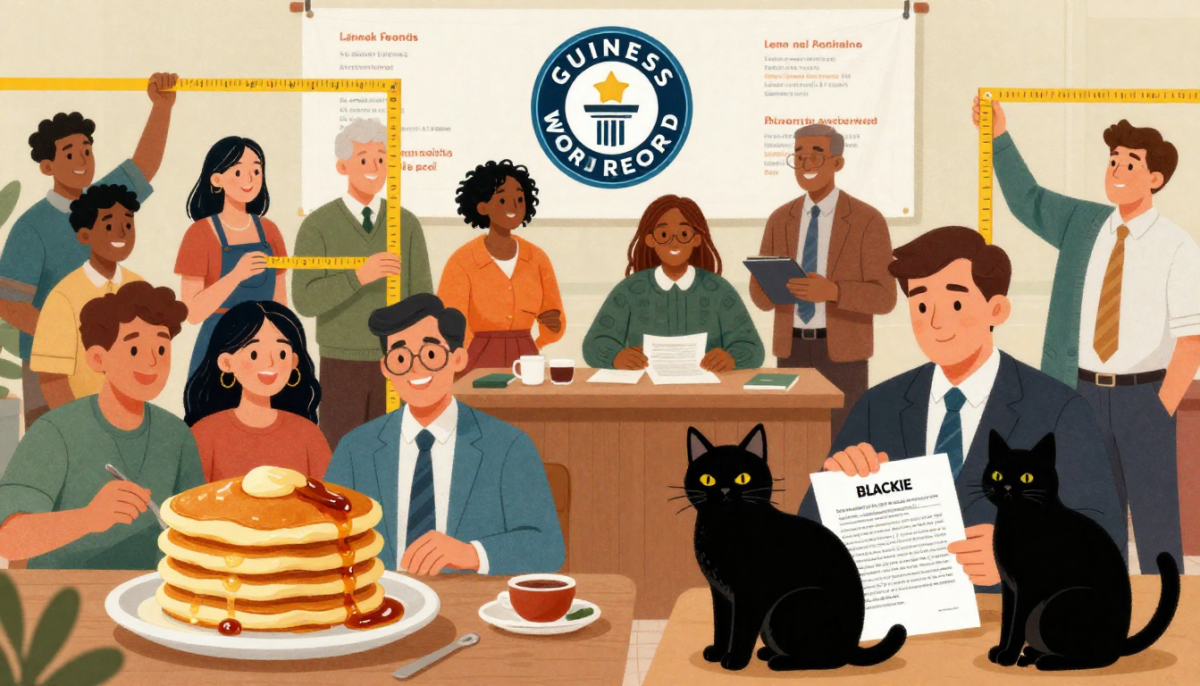
- billionaire Ben Rhee, who left $12.5 million to his cat Blackie
- Fox Sports' experiments with measuring punch strength
But if you look at them more broadly, a social dimension becomes apparent. The story of Cha Sa Sun illustrates institutional persistence and the bureaucratic procedures of South Korea's examination system. The pancake-flipping record demonstrates collective mobilization and event marketing within the university environment.
Even the "richest cat" is not so much about the animal as it is about the legal construct of a hereditary trust and charitable organizations.
The record captures not only a physical achievement but also the social context.

Myth #5. Records are always about the limits of physical capabilities.
It is commonly believed that the book records exclusively physical extremes - speed, strength, endurance. However, many categories do not touch upon physical limits at all.
The record for the richest cat, Blackie, is primarily a legal and financial case. After the death of Ben Rea in 1988, $12.5 million was distributed through charitable structures with the condition of caring for the animal. There is no physical boundary here - only a legal structure of inheritance.
The same applies to records related to mass events, such as collective pancake flipping. This is not a test of human endurance, but a demonstration of organizational ability.
Guinness records any measurable maximums - not just biological ones. It is a catalog of quantitative superiority in a broad sense.
Myth №6. Records have no cultural significance and exist only for entertainment.
Superficial perception makes the book a part of pop culture. However, upon closer analysis, it becomes clear that many records reflect specific cultural codes of the time.
For example, television records like the Fox Sports experiment measuring the strength of a groin strike are products of the media show era and ratings competition. The very act of measuring such an indicator speaks to the commercialization of spectacle.
The story of Michel Lotito demonstrates the public's interest in human anomalies and the limits of physicality. In academic circles, such cases are discussed within the framework of studies on rare eating disorders.
The record book serves as a kind of archive of cultural priorities - it captures what society currently considers worthy of attention.

Myth #7. Record holders are random people without preparation.
Some stories seem spontaneous, but they are backed by systematic preparation.
Mohammed Hussein Kurshid trained for 3 years, daily for 6 hours, to type 103 characters with his nose in 47 seconds. That's 18,000 hours of training - a volume comparable to professional sports.
Even mass records require planning, participant registration, time control, and documentation procedures. A record is not an impulsive action, but a pre-calculated project.
Guinness creates a formal goal, around which discipline is built. In this sense, the structure resembles sports federations, although the object of competition may be unusual.

Myth #8. The Book of Records encourages meaninglessness
Skeptics often claim that recording such achievements stimulates meaningless activity. However, the logic of records is closer to the scientific principle of measurability.
Any record is a numerically expressed superiority. It requires a clear methodology, reproducibility of conditions, and independent verification. Essentially, it is a formalized procedure of verification.
If we remove the emotional assessment, we are left with a basic mechanism: measure, confirm, document.
One can argue about the value of the achievement itself, but the procedure itself is neither chaotic nor irrational. It relies on the principle of objective control.

Myth #9. Records exist outside of economic interests.
Guinness World Records has long turned into a commercial brand. Record registration, hosting official events, and the involvement of judges - all of this is part of the business model.
Companies use records as a marketing tool. Mass events, corporate attempts to set achievements, television shows - these are ways to attract attention and create media buzz.
Thus, the record book functions simultaneously as a cultural archive and as a commercial platform. These two functions do not contradict each other but enhance the mutual effect.

Sources:
Strange Guinness records are not a random collection of absurdities. They are the result of an institutional measurement system, a commercial logic of popularity, and a cultural need to demonstrate extreme capabilities - sometimes physical, sometimes social.
When the shock effect is removed, it becomes clear: we are not facing chaos, but a structured catalog of human aspiration to stand out and be recorded in history.
- Guinness World Records. Guinness World Records 2023 Edition. London: Guinness World Records Limited.
- Norris McWhirter, Ross McWhirter. Guinness Book of Records. First Edition. London, 1955.
- Guinness World Records official website - guinnessworldrecords.com
- American Psychiatric Association. Diagnostic and Statistical Manual of Mental Disorders, 5th Edition - section on pica.
- BBC News archive materials on Cha Sa Sung and Michel Lotito.
You might like

Festivals We Misunderstand
Festivals are often described as a universal language of joy. Tourist websites promise emotions, guides - scale, bloggers - unforgettable experiences. But behind ...

15 of the Strangest New Year's Traditions from Around the World
New Year is considered a universal holiday. It seems to erase borders: in different countries, people summarize the year, make plans, and set wishes. ...

The History of Car Logos: What Do These Symbols Really Mean?
The car logo is more than just a decorative element on the hood. It encapsulates the brand's history, its ambitions, technological achievements...