
This is why the history of LEGO is more complex than it seems.
The history of LEGO is often presented as an almost flawless entrepreneurial legend: a master from a provincial Danish town, a crisis, a bold decision to switch to plastic - and then a continuous rise to global success. Such a narrative is convenient, but it smooths over complex and fundamental details: the borrowing of the "brick" idea, technological risks, unsuccessful product lines, financial crises already in the 21st century, the real structure of ownership and management.
Why is this important today? LEGO is one of the few large toy manufacturers that remains family-owned while also being global. It is often cited as an example of "timeless classic," a sustainable business, and an ideal product philosophy. However, to understand how the company truly established its position, one must separate corporate myth from verifiable facts.
Let’s examine the key theses that are most frequently repeated in the popular retelling of LEGO's history and check how accurate they are.
Myth #1. LEGO was originally created as a toy company.
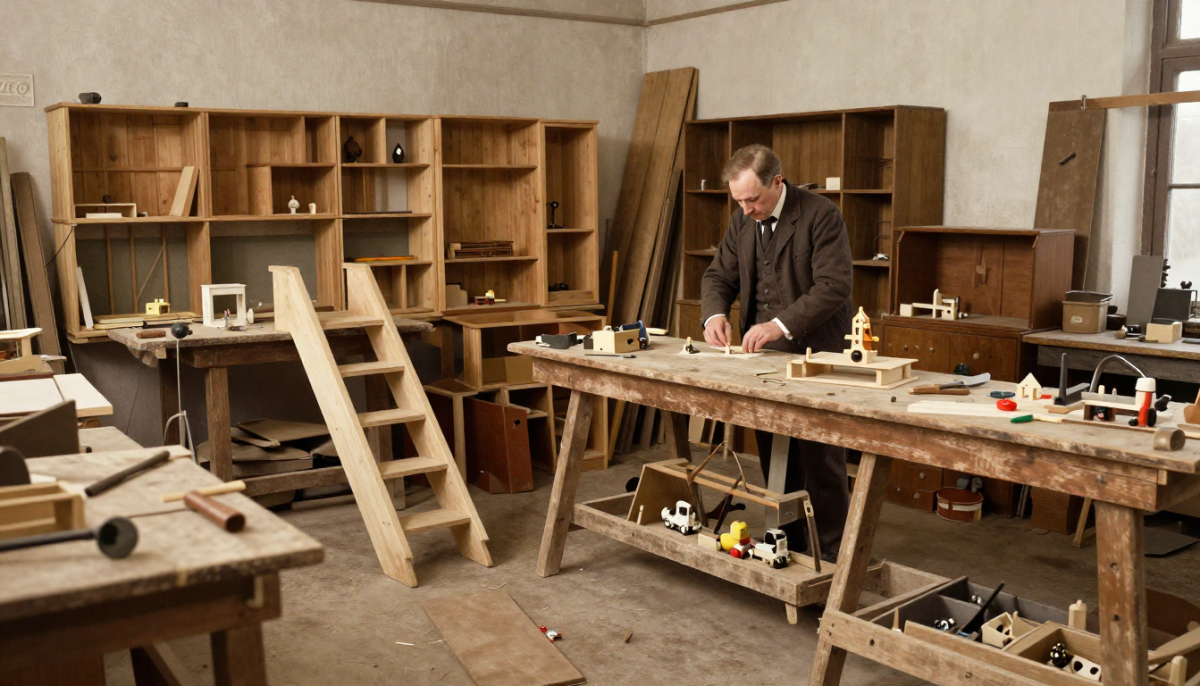
In popular accounts, it creates the impression that in 1932 Ole Kirk Christiansen immediately founded a toy company. In fact, everything was more complicated.
Christiansen was a carpenter and had been running a workshop in Billund since 1916. He produced furniture and interior elements. Toys emerged as part of a survival strategy during the economic crisis of the early 1930s. In 1932, the workshop did indeed shift its focus to producing wooden toys, but it simultaneously continued to manufacture ladders, ironing boards, and household items.
Even after the name LEGO appeared in 1934, the company was still not "purely toy-focused" for a long time. It was a small manufacturing workshop with a diversified product range. The toy specialization gradually became dominant, rather than being established at the moment of founding.
This is important: the success of LEGO was not the result of an initially precise strategic vision of the toy market. It grew out of a forced adaptation to economic conditions.
Myth #2. LEGO invented the plastic brick.
One of the most persistent myths is that the branded "brick" was completely invented in Denmark.
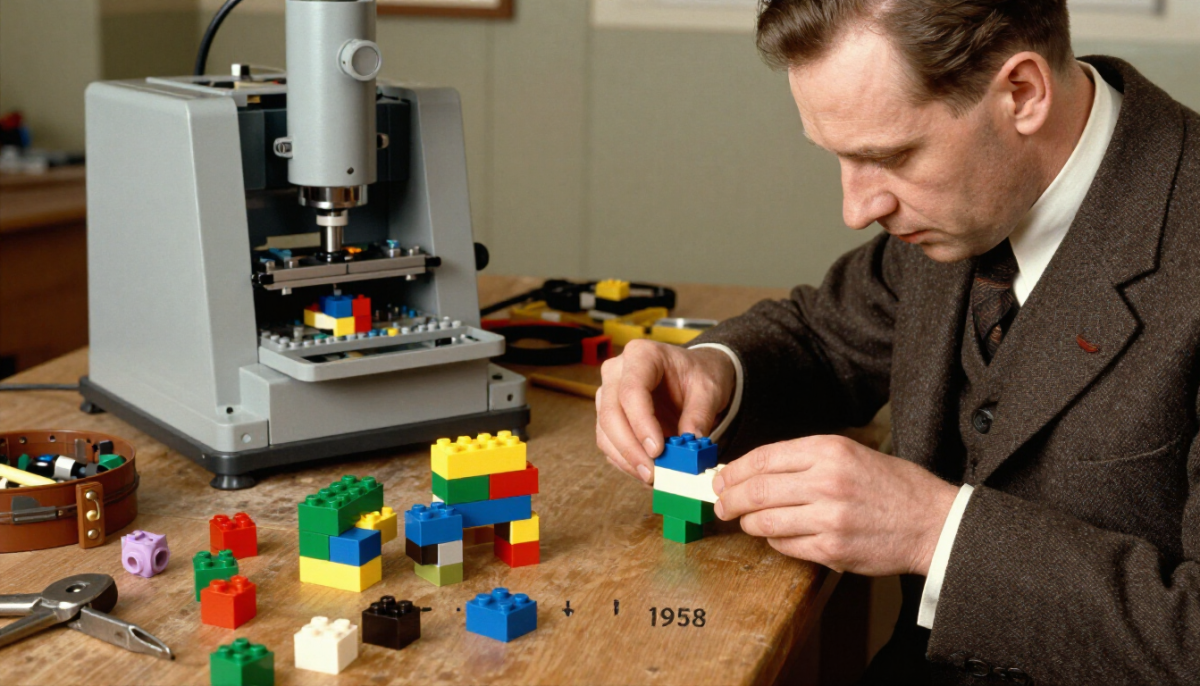
In fact, the prototype of interlocking plastic cubes appeared in the United Kingdom. The company Kiddicraft released Interlocking Building Cubes back in the 1940s. Their design had limited strength of connection, but the principle of joining was already established.
LEGO acquired an injection-molding machine in 1946 and began producing its own versions of such cubes. A significant technological difference emerged later - in 1958, a brick with internal tubes was patented, which provided a strong fixation and compatibility of parts from different production years.
This design became the basis of the modern system. That is, LEGO did not invent the principle of interlocking cubes itself, but developed a more advanced and standardized version, which ensured long-term success.
Myth #3. The transition to plastic was an instantly successful and obvious decision.
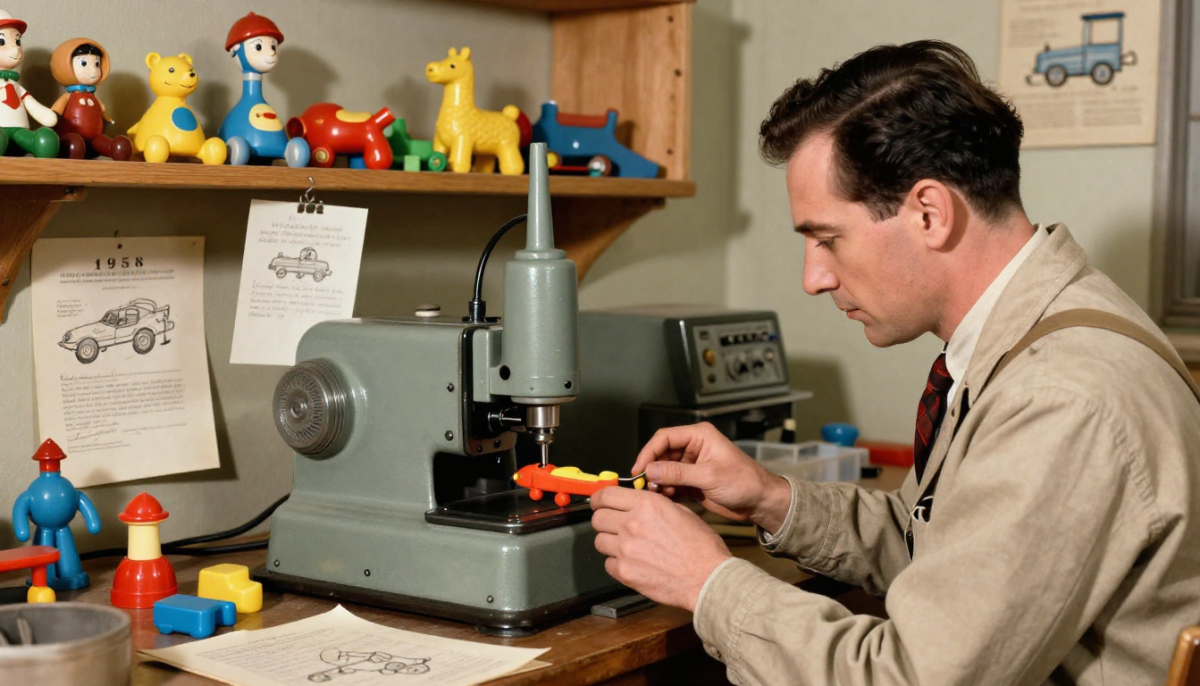
In retelling, the story of the purchase of the injection molding machine in 1946 appears as a brilliant intuitive move that immediately paid off. In practice, plastic was long viewed with skepticism.
In the late 1940s and early 1950s, plastic toys were considered less prestigious than wooden ones. Sales of "bricks" were slow. It wasn't until 1955 that the concept of the System of Play was introduced - a unified play system where sets complemented each other. It was not just a product, but an architecture of the assortment.
Moreover, a true technological standard was established only after the patent of 1958. Before that, LEGO experimented with shapes, sizes, and connections.
The decision to switch to plastic turned out to be strategically correct, but its success was the result of a decade of refinements and conceptual repackaging of the product.
Myth #4. LEGO has always been a sustainable and undeniably successful company.
In the popular narrative, after the 1950s, there is a continuous growth trajectory. However, in the early 2000s, the company experienced a serious crisis.
By 2003-2004, losses reached hundreds of millions of euros. The company expanded into video games, clothing, theme parks, and new product formats, some of which turned out to be unprofitable. It was during this period that a large-scale reform was conducted: optimizing the assortment, reducing costs, and focusing on key lines such as Technic and licensed series.
The return to systematic approaches and strict control of product architecture became more important than the constant expansion of the brand's universe.
LEGO indeed remains a family-owned company, but its resilience is the result of management decisions and painful adjustments, rather than continuous infallibility.

Myth #5. LEGO has no real competitors - it is a unique and unattainable brand.
Today, LEGO is often perceived as a synonym for construction toys in general. In everyday speech, the word has become generic. This creates the impression that the company has always been uncontested.
In fact, the market for construction toys has been saturated and competitive since the 1950s. In the USA, companies like Tyco and Mega Bloks were actively operating. The latter even engaged in legal disputes with LEGO over the shape of the brick. In 2008, the European Court ultimately ruled that the shape of the standard brick cannot be protected as a trademark, as it serves a technical function.
This meant that LEGO does not have a legal monopoly on the very principle of the brick. The competitive advantage is built not on an exclusive right to the shape, but on the quality of production, standardization of tolerances, brand strength, and the scale of the ecosystem.
It is noteworthy that the company consciously bets on the compatibility of parts from different decades. This is an engineering discipline, not a marketing trick. In the absence of a formal monopoly, it is the precision of production that has become a barrier for competitors.
Myth #6. LEGO is just a toy for kids.
Officially, the company has long positioned itself as a manufacturer of children's toys. However, starting from the late 1990s, the situation changed.
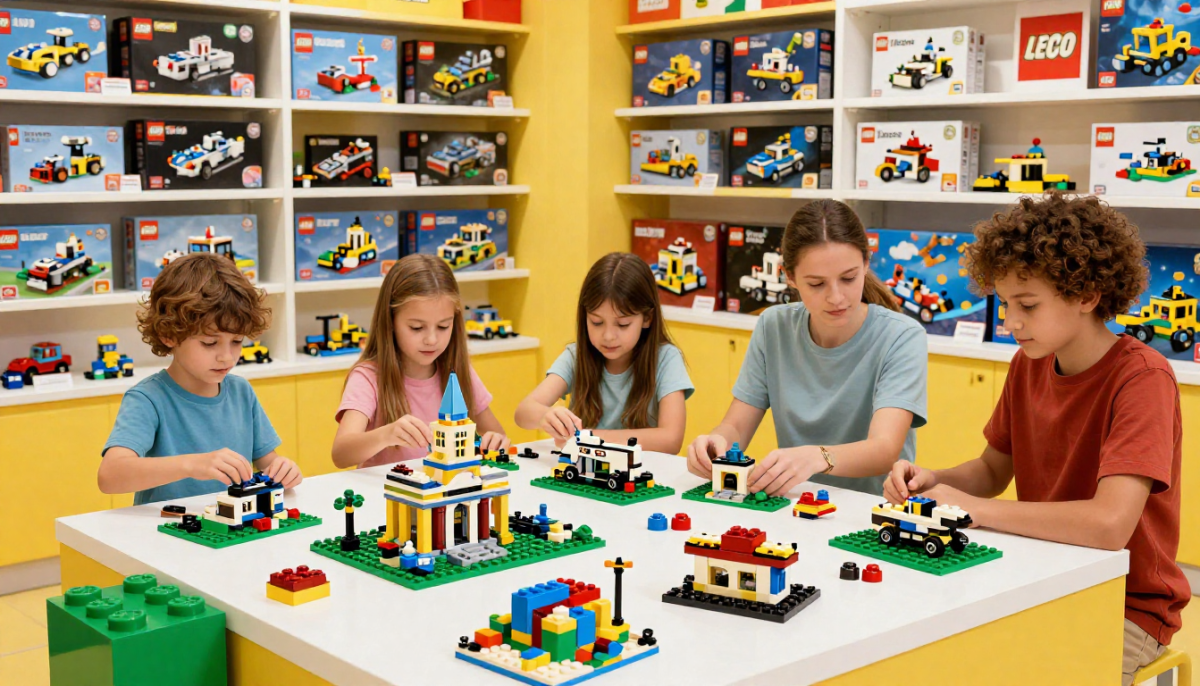
In 1998, the first version of Mindstorms was released, aimed not only at children but also at the educational market and technical clubs. Later, large collectible sets for adults appeared - architectural series, complex Technic models, replicas of cinematic objects.
By the 2020s, the AFOL segment - Adult Fans of LEGO - had become a significant part of revenue. The company openly refers to adult buyers as a strategic audience. Sets with an age rating of 18+ are not a marketing exotic, but a systematic line of development.
Thus, LEGO has long ceased to be exclusively a children's brand. It operates simultaneously in three segments - children's play, educational solutions, and the adult hobby market.
Myth #7. Family management automatically guarantees stability
It is often emphasized that LEGO remains a family company. Indeed, the controlling stake belongs to the Kristiansen family through the Kirkbi holding. However, this often leads to the conclusion that the family structure itself ensures stability.
History shows a more complex picture. During the crisis period of 2003-2004, leadership was handed over to professional manager Jørgen Vig Knudstorp - the first CEO not from the founding family. It was under his management that the company underwent restructuring and returned to profitability.
The family retained strategic control, but operational management was professionalized. This is an important nuance. LEGO is not an example of a romantic "family craft," but a model combining long-term family ownership and corporate management.
Stability is ensured not by the fact of kinship, but by the institutional governance structure.
The history of LEGO is not a straight line from a workshop to global triumph. It is a story of adaptation to crises, technological borrowing followed by refinement, a long search for a product model, and management mistakes that had to be corrected.
The main factor in the company's success is not just "simplicity and versatility," but systematic standardization of the product and strategic discipline in managing the assortment.
Sources
- Robertson, David C., Breen, Bill. Brick by Brick: How LEGO Rewrote the Rules of Innovation and Conquered the Global Toy Industry. Crown Business, 2013.
- Rasmussen, Niels Lunde. The LEGO Story: How a Little Toy Sparked the World’s Imagination. LEGO Group, 2021.
- LEGO Group. Annual Reports 2003-2005.
- Patent GB 529580 - Interlocking building bricks, Hilary Fisher Page, 1940.
- LEGO Patent DK 92683 - Building brick with improved coupling means, 1958.
You might like

Elon Musk - Genius or Calculating Entrepreneur? What Really Lies Behind His Story
The story of Elon Musk has long turned into a modern entrepreneurial legend. He is called a visionary, an adventurer, a genius, a disruptor of industries...
China on the path to global leadership: how sustainable is this growth?
China has undergone a transformation in recent decades that took centuries in other countries. From an agrarian, poor nation torn by internal conflicts...